Transfer Pricing Alert - Amendments in Safe Harbour Rules

Transfer Pricing Alert - Amendments in Safe Harbour Rules

  • TaxWire
  • Transfer Pricing Alert - Amendments in Safe Harbour Rules

Following the proposal made in the Union Budget 2025 by the Finance Minister for expanding the scope of safe harbour rules, the Central Board of Direct Taxes (CBDT) has introduced certain amendments vide its notification No. 21 dated 25th March 2025. These amendments are aimed at reducing litigation and providing certainty in international taxation. Let us explore the amendments and their corresponding impact on the business in this edition of our TaxWire.


Background

Safe harbour rules are simplified compliance guidelines for resident Indian entities dealing with their foreign group entities. Instead of going through detailed documentation and scrutiny to prove fairness in international transactions, eligible businesses and transactions can follow a pre-defined path prescribed in the Income Tax Regulations, where they get acceptance of pricing to be at arm’s length without further questioning. 

These rules foster simplification of compliance, reduce litigations and disputes, and offer certainty for eligible international transactions in the area of software development services, IT-enabled services, intra-group loans, corporate guarantees, manufacture and export of auto components, etc.  

image

Key Amendments – Expanding the Scope

  • Expansion of “Core Auto Components” under Rule 10TA

    • The definition of core auto components has been expanded to include “lithium-ion batteries for use in electric or hybrid electric vehicles”. 

  • Increase in Turnover Thresholds under Rule 10TD 

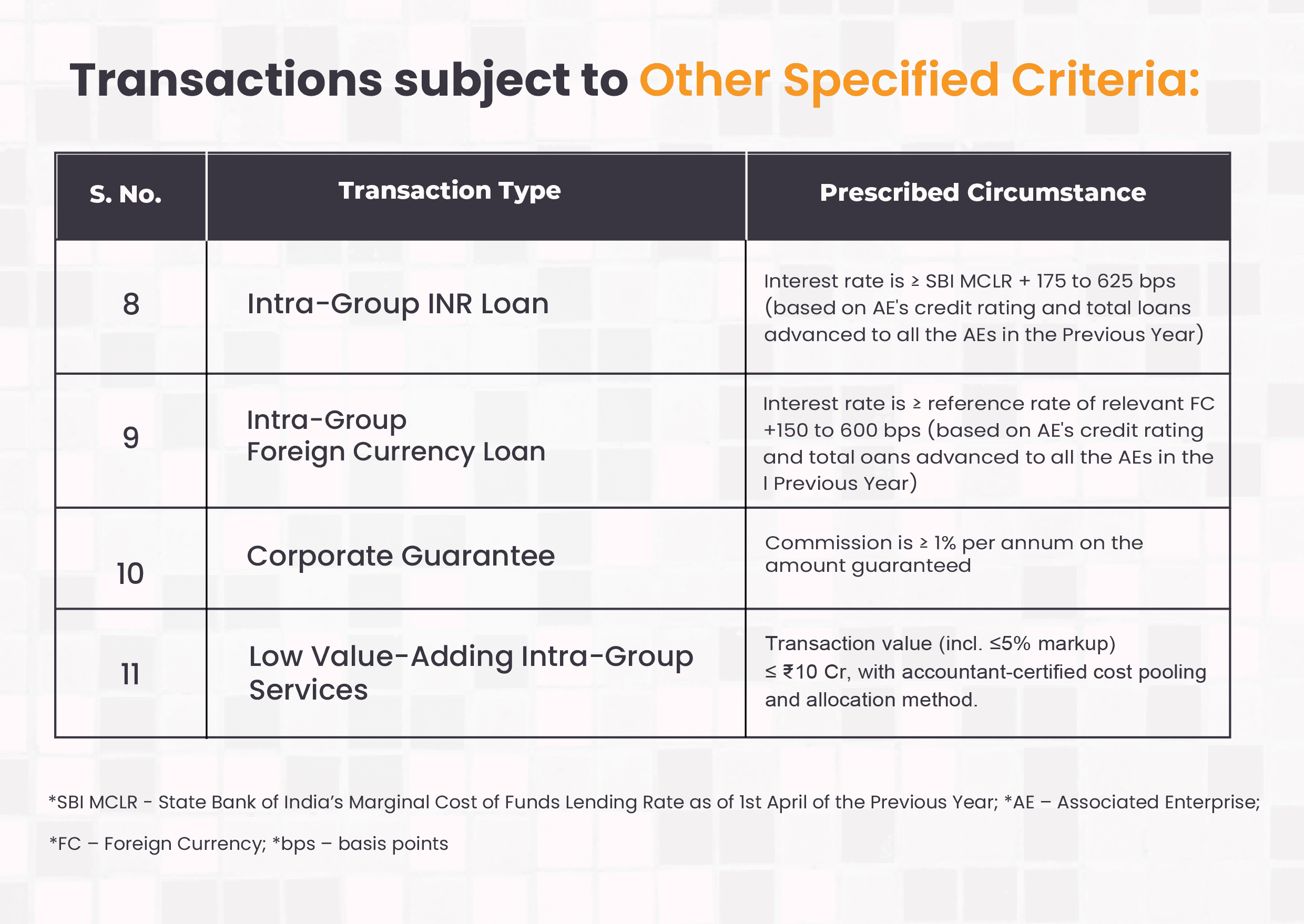
    • Rule 10D sets operating profit margin based on turnover thresholds for certain eligible transactions, on satisfaction of which the company’s transfer price would be accepted to be at arm’s length. CBDT has amended such upper turnover thresholds from ₹200 Cr to ₹300 Cr. The comprehensive amended table under Rule 10TD (2A) is given below:

      image (18).png

      image (20).png


  • Extension of validity of safe harbour provisions under Rule 10TD (3B)

    • Safe harbour provisions are extended for assessment years 2025-26 and 2026-27. Previously, they were applicable from AY 2020-21 to AY 2024-25.

  • Validity of the safe harbour rule for one year at a time under Rule 10E (2)

    • The fourth proviso to sub-rule (2) of Rule 10E has been amended to say that, when the safe harbour option is exercised under Rule 10D(3B), the provision allowing multi-year applicability will no longer apply. Hence, the safe harbour benefit in this context is now valid for only one year at a time.

Advith’s Comments

  1. Inclusion of EV Battery Components: The expansion of the definition “core auto components” brings in more EV battery manufacturers and suppliers into safe harbour provisions. It boosts the electric vehicle ecosystem by offering them simplicity and certainty in transfer prices.

  2. Higher Turnover Thresholds: Increase in turnover thresholds widens the inclusion of multinational entities and reduces the process of litigation and scrutiny. With more entities entering the safe harbour provisions, tax certainty and simplified compliance will be broadened.

  3. Extended Validity: Extension of validity of safe harbour provisions till AY 2026-27 provides stability, continuity and predictability for taxpayers to plan their pricing.

  4. Annual Filing Requirement: The procedural change of application of Rule 10TD (3B) for one year at a time instead of multiple years option requires taxpayers to file Form 3CEFA every year. This aims to achieve greater regulatory control and requires taxpayers to reaffirm margins every year. With this, the scope of Rule 10TE (2) will be of historical relevance (for earlier schemes) and for future new rules.