


How DPA Helps Growing Businesses Eliminate Month-End Chaos
I. Introduction
Month-end chaos is one of the persistent concerns faced by businesses across every spectrum. Especially in FinOps (Financial Operations), finance teams in every organisation have to rush during this time, reconciling accounts, compiling reports, submitting statutory filings, and fixing discrepancies under immense pressure and tight deadlines.
The stress is real, the stakes are high, and the chaos is often inevitable, but it does not have to be this way. With Digital Process Automation (DPA), there has been a structured and technology-driven approach that has changed the way the finance teams across businesses work during the month-ends. In continuation of our previous blogs on DPA, let’s explore in this blog how the adoption of DPA can change the month-end chaos.
II. The Impact of Month-End Chaos on Growing Businesses
The month-end closures and statutory filings are some of the most critical processes for FinOps teams in growing businesses. At Advith ITeC, we have seen firsthand how businesses get impacted due to end-moment financial chaos. Let us have a quick look at some of the challenging scenarios during month-ends.
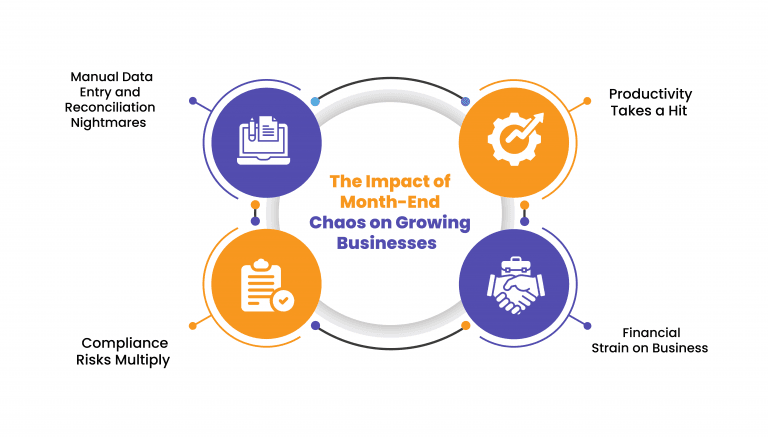
1. Manual Data Entry and Reconciliation Nightmares
Most growing companies rely heavily on emails, spreadsheets, and other scattered documentation, which often leads to inconsistent data entry, version control problems, and frequent reconciliation discrepancies. Errors crop up regularly, and identifying their root causes becomes a never-ending puzzle.
2. Productivity Takes a Hit
Key finance and accounting personnel are pulled into the month-end closure cycle every month, resulting in a loss of valuable working hours for the organisation. Hours that could be spent on strategic operations to enhance business and revenue are instead drained by routine checks, data cleansing, and back-and-forth communications during month-ends.
3. Compliance Risks Multiply
Missed statutory deadlines, misreported numbers, and inadequate documentation can lead to compliance risks, resulting in regulatory penalties and loss of stakeholder trust. Month-end chaos leaves little room for careful compliance review and increases the chances of oversight.
4. Financial Strain on Business
Delayed or inaccurate reporting affects decision-making. Founders and business leaders are left bridging gaps and filling blind spots when they should be steering the business with clarity. Especially for startups and SMEs, such delays can result in missed investment opportunities or poor cash flow planning.
III. How DPA Brings Order to Month-End Closes
Adopting Digital Process Automation is not just about automating tasks. It is about creating and adapting to processes that are not only smarter and more efficient but also part of an interconnected ecosystem where data flows smoothly, every task is tracked properly, and people can work with clarity and confidence. Let us now see in detail how DPA can alleviate the typical month-end pressure.
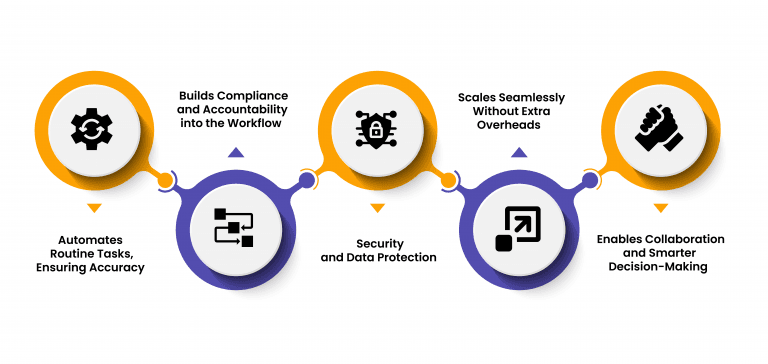
1. Automates Routine Tasks, Ensuring Accuracy
DPA automates repetitive tasks like journal entries, invoice processing, reconciliations, and report generation through rule-based workflows. This reduces human error, avoids last-minute scrambles with real-time syncing of data, and ensures finance teams have reliable numbers at their fingertips.
2. Builds Compliance and Accountability into the Workflow
Checks and balances are embedded into every process step through automated validations, tax rule checks, and audit trails. At the same time, DPA provides task assignment, tracking, and notifications, creating accountability and visibility so responsibilities are clear, and any holdups are flagged early.
3. Security and Data Protection
Financial data is highly sensitive, and DPA tools hosted on secure cloud environments provide encryption, access control, and secure backups. This ensures data integrity and compliance with global standards, protecting businesses from risks while building stakeholder confidence.
4. Scales Seamlessly Without Extra Overheads
As businesses grow, the volume and complexity of transactions multiply. DPA scales with this growth, managing higher workloads efficiently without the need for proportional increases in manpower or costs.
5. Enables Collaboration and Smarter Decision-Making
Month-end closures require inputs across finance, sales, procurement, and operations. DPA integrates these functions, streamlining collaboration and ensuring accurate, timely reports. This gives leaders trustworthy insights to make informed decisions on budgeting, investments, and resource allocation.
IV. A New Way Forward: Smarter Closures, Scalable Systems
In today’s fast-paced world, growing businesses need more than survival tactics. They must constantly evolve to scale. A way forward lies in adopting automation and moving towards continuous accounting, where month-end is no longer a fire drill but a well-managed routine. With DPA at the core, finance functions become smarter, scalable, and future-ready, while strategic financial guidance ensures businesses grow with clarity and confidence.
V. Conclusion
Month-end chaos need not be inevitable. Digital Process Automation enables finance teams to move from stress to structure, building scalable systems that support growth. Most importantly, tailored DPA frameworks ensure smoother month-ends, stronger compliance, and a decision-making infrastructure that grows with you. Investing in DPA is not just about today’s convenience, it is about creating the readiness to thrive tomorrow.
Also Read: Enhancing Financial Accuracy and Efficiency with Digital Process Automation (DPA)
Also Read: Transforming SME FinOps with Digital Process Automation
Contributors:
N Srilatha Bhat- Linkedin
Kuldeep Sarma- Linkedin
Poonam Vernekar- Linkedin
Popular Searches - Enhancing Financial Accuracy with Digital Process Automation (DPA) | The Power of Virtual Finance Office (VFO) | 5 Financial Processes to Automate Using Zoho Books | Understanding Debentures: A Comprehensive Guide | The Power of Transfer Pricing Beyond Compliance | Joint Development Agreement (JDA): A Comprehensive Guide | The Power of Smart Budgeting | How Tech Enabled Outsourcing | What Is a Virtual Finance Office | Strategies for Maximizing Your Outsourcing ROI | Simplifying Regulatory Compliance | How Tech-Enabled Outsourcing is Transforming the CFO’s Role | How a Virtual Finance Office Covers It All | Competition Law in India | Critical Yet Non-Core Functions Made Simple | Outsourcing FinOps: A Strategic Edge for Businesses | GIFT City: Reinforcing India’s Global Presence | Guide for Companies to Navigate the Regulatory Landscape | Pradhan Mantri Viksit Bharat Rozgar Yojana | Transforming SME FinOps with Digital Process Automation | Automation in FinOps: The Key Areas & Ways to Automate | Well planned HR Structure in Sustainable Organization
