


Transforming SME FinOps with Digital Process Automation
I. Introduction
Small and Medium-sized Enterprises (SMEs) form the backbone of the Indian economy—accounting for about 30% of the nation’s GDP[1]. They operate across diverse sectors, including manufacturing, trade, banking, IT, and IT-enabled services (ITES). SMEs are engines of economic growth and industrial development, playing a significant role in both domestic output and global trade. In fact, MSMEs accounted for 45.73% of India’s total exports in 2023–24, a figure that further increased to 45.79% by May 2024, underscoring their rising influence in the country’s trade performance.
Despite their critical role in driving exports, industrial output, and inclusive growth, SMEs are often found to grapple with inefficiencies when it comes to financial operations. Digitisation, especially Digital Process Automation (DPA) in Finance, offers the much-needed solution to this paradox. However, the adoption and implementation of DPA in Finance remain slow due to persistent myths around cost, complexity, and the perceived loss of control. Many SMEs still believe that automation is only for large enterprises and fear that it may disrupt their existing workflows.
[1] Press Release: Press Information Bureau
III. Role of Digital Process Automation in SME FinOps
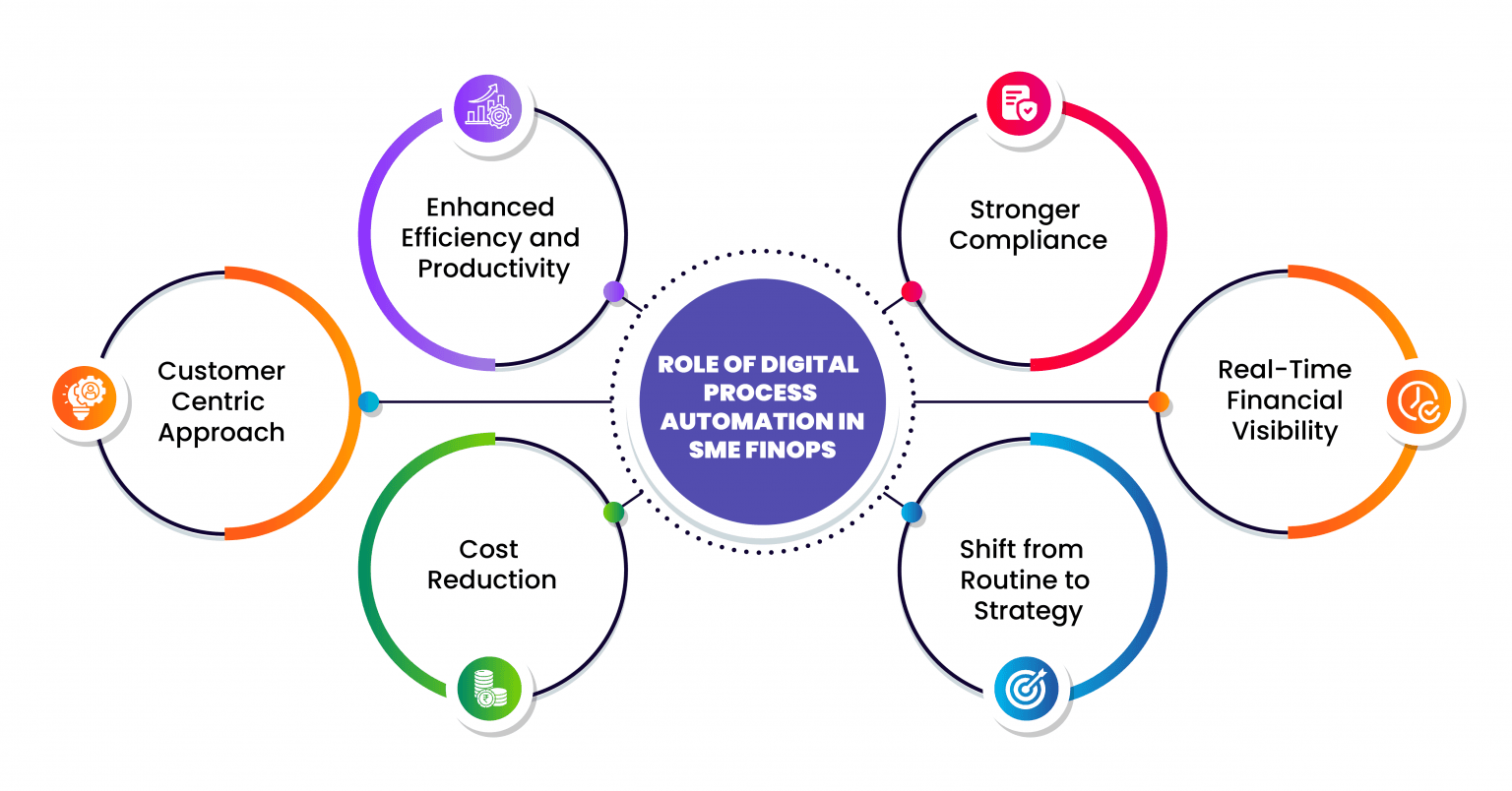
Digital Process Automation has revolutionised the financial management landscape for SMEs. Let us discuss in detail the transformations that have taken place due to automation in financial management.
1. Enhanced Efficiency and Productivity
Adoption and implementation of DPA in finance helps SMEs speed up repetitive tasks such as data entry, invoice matching, and reconciliations, while reducing the chances of errors. According to recent industry insights, financial automation can reduce reporting errors by up to 90% and help teams to complete financial processes up to 85 times faster[2],, leading to substantial improvements in accuracy, speed, and overall efficiency.
[2] Finance Automation: Benefits & Expert Tips
2. Customer-Centric Approach
Faster invoicing, real-time updates, and responsive reporting improve the experience for customers resulting into enhanced customer satisfaction. A customer-focused approach helps SMEs build trust and grow through positive word of mouth.
3. Cost Reduction
Digital Process Automation (DPA) helps cut costs by reducing reliance on manual labour through automation of repetitive tasks, thereby lowering operational overhead. By accelerating processes and enabling better resource allocation, DPA allows businesses to scale without proportionally increasing costs.
4. Stronger Compliance
Navigating regulations is critical for SMEs. By providing real-time monitoring, clean documentation, and automated audit trails, DPA ensures accurate filings and reduced compliance risks.
5. Real-Time Financial Visibility
Automated dashboards, integrated reporting tools, and cloud-based accounting systems provide real-time insights into key metrics like cash flow, profitability, and overall performance. This level of visibility enables businesses to manage working capital more effectively and timely, data-driven strategic decisions.
6. Shift from Routine to Strategy
With less time spent on manual tasks, finance teams can focus on strategic work than routine repetitive tasks. Further, automation empowers CFOs and finance leaders to make more impactful, data-driven decisions that drive business growth.
IV. How We Do DPA: Our Approach to Enabling Digital Process Automation
Our approach to Digital Process Automation (DPA) in Finance goes beyond just automating. Our strategic approach is not just aimed at automating the repetitive tasks; rather it’s specifically aimed at transforming the financial operations with precision, strategy, and measurable outcomes. At Advith ITeC, we follow a structured 9-step DPA methodology, refined through our years of experience, to ensure smooth transitions and deliver automation solutions:
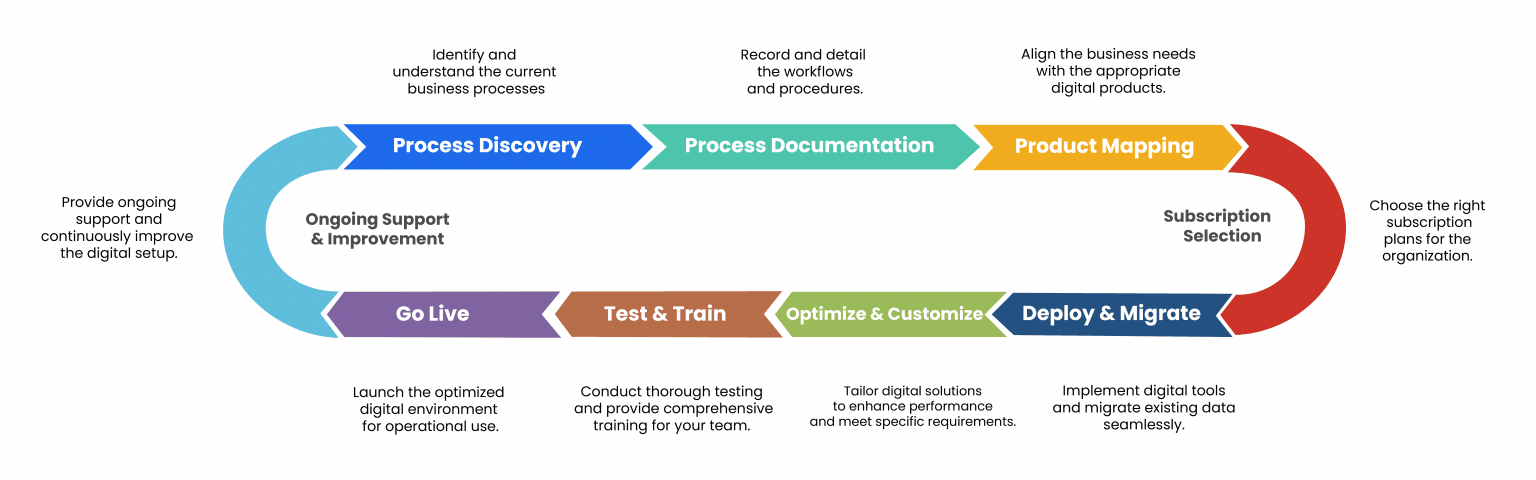
Our DPA approach has consistently delivered measurable improvements in reporting accuracy, regulatory compliance, error reduction, and faster decision-making. For instance, in a recent engagement with a leading SaaS company, we uncovered and corrected three years’ transactional discrepancies and completely transformed their finance function through the Zoho Finance Suite. This transformation not only streamlined their processes but also enabled real-time visibility and control. Whether you’re a startup or an established enterprise, our structured approach ensures your financial operations are future-ready, compliant, and built for scale.
V. What’s Next in Digital Process Automation?
As technology continues to evolve, Digital Process Automation (DPA) is set to unlock new opportunities for SMEs, enabling more agile, accurate, and efficient financial operations. Some key emerging trends in DPA include:
1. Hyper-Automation in FinOps
The integration of RPA, AI, machine learning, and advanced analytics is driving end-to-end automation across financial workflows, minimizing manual intervention and maximizing accuracy.
2. Next-Level Predictive Analytics
Predictive analytic systems are expected to reach the next level of evolution with a more efficient forecasting of cash flow trends, revenue, and cost behaviour patterns through extensive use of AI.
3. Self-Reliant Platforms
Next-gen automation tools are empowering finance teams to independently design and manage workflows, reducing IT dependency and fostering a self-reliant finance function.
4. Conversational Interfaces
Voice and chatbot-driven interfaces are expected to enhance user experience and reduce frictions in managing FinOps for SMEs.
VI. Conclusion
Digital Process Automation (DPA) is transforming SME FinOps by streamlining operations, reducing costs, and supporting business growth without increasing headcount. The advancements in DPA might sound like fiction, but that is not the case anymore. These innovations are already a reality, and businesses that adopt them early will naturally gain an edge over their competitors.
At Advith ITeC, we specialize in seamless DPA implementation—helping SMEs scale without disruptions. Get in touch with us to automate your finance processes and unlock strategic value for your business.
Also Read: Top 5 Financial Processes to Automate Using Zoho Books
Contributors:
CA N Srilatha Bhat – LinkedIn
Kuldeep Sarma – LinkedIn
Poonam Vernekar – LinkedIn
Popular Searches - How Tech Enabled Outsourcing | Outsourcing FinOps: A Strategic Edge for Businesses | How DPA Helps Growing Businesses | The Power of Virtual Finance Office (VFO) | Enhancing Financial Accuracy with Digital Process Automation (DPA) | Understanding Debentures: A Comprehensive Guide | Critical Yet Non-Core Functions Made Simple | Pradhan Mantri Viksit Bharat Rozgar Yojana | GIFT City: Reinforcing India’s Global Presence | How a Virtual Finance Office Covers It All | What Is a Virtual Finance Office | Well planned HR Structure in Sustainable Organization | How Tech-Enabled Outsourcing is Transforming the CFO’s Role | Automation in FinOps: The Key Areas & Ways to Automate | Joint Development Agreement (JDA): A Comprehensive Guide | Guide for Companies to Navigate the Regulatory Landscape | Simplifying Regulatory Compliance | Competition Law in India | 5 Financial Processes to Automate Using Zoho Books | Strategies for Maximizing Your Outsourcing ROI | The Power of Smart Budgeting | The Power of Transfer Pricing Beyond Compliance
